

–:– / –:–
This voice experience is generated by AI. Learn more.
This voice experience is generated by AI. Learn more.
Summary
Zack London, known online as Gossip Goblin, is bringing his AI-assisted anthology feature “Gods Don’t Give Gifts” to U.S. theaters on October 30. His darkly comic science-fiction worlds are filled with mutated aristocrats, synthetic bodies and predatory corporations, but London insists AI is a tool, not the point. It gave him access to filmmaking without replacing crafts he already valued, such as illustration. A self-described generalist, he favors maximalist storytelling, human performers and distinctive worlds over repetitive, algorithm-friendly content. His goal is simple: for audiences to discuss the films, not the technology behind them.

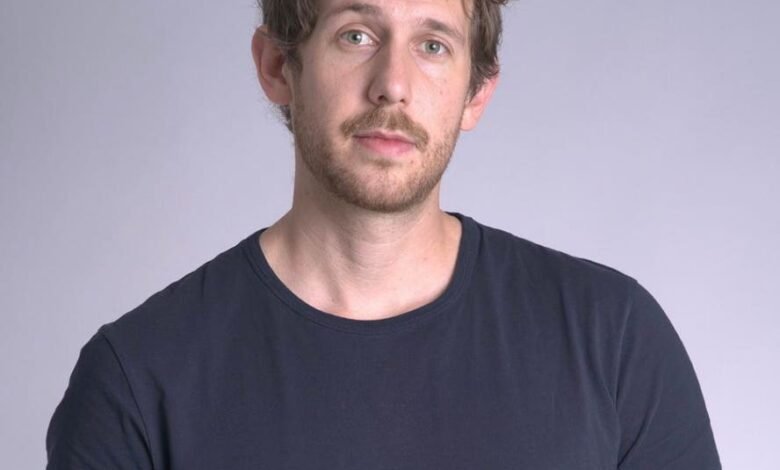
Zack London, the filmmaker known online as Gossip Goblin.
Courtesy of Gossip Goblin
Zack London, better known to several million people online as Gossip Goblin, does not divide his days neatly between filmmaking and everything else. His daughter’s waking and sleeping hours provide the only fixed points.
He might take a call while playing blocks
He might take a call while playing blocks with her, handle an urgent company problem, then return after bedtime to scripts, storyboards and the accumulating lore of a fictional universe in which humanity repeatedly invents elaborate ways to destroy itself.
Eight hours of sleep, he jokes, is “a luxury we don’t have right now.”
London has spent three years constructing civilizations populated by mutated aristocrats, synthetic bodies and malevolent corporations whose sophistication has done remarkably little to improve human judgment.
His films are grotesque and unexpectedly funny, their characters speaking with the verbal dexterity of drawing-room comedy while their bodies and societies collapse around them.
On October 30, that universe moves from social-media
On October 30, that universe moves from social-media feeds into U.S. theaters with Gods Don’t Give Gifts, an anthology feature produced by Fable, the studio led by Edward Saatchi.
Yet the more time you spend talking to London, the less his story sounds like one about artificial intelligence and the more it becomes one about somebody who finally found a medium large enough to accommodate him.
MORE FOR YOU
ForbesYouTuber Gossip Goblin Will Debut AI Film ‘Gods Don’t Give Gifts’ In U.S. Theaters
London studied sculpture and anthropology at the Claremont
London studied sculpture and anthropology at the Claremont Colleges before spending years in product design. Throughout it all, he kept drawing and writing.
When image generators arrived, he drew a line: illustration was a craft he had spent years acquiring, and he had no interest in handing it to a machine.
Filmmaking was different. It was a craft he had never possessed the re made filmmaking available to him. He describes AI as “the most creative tool ever,” and compares using it to reproduce familiar cinematic conventions to greeting the invention of film by pointing a camera at a stage play
His impatience with derivative work has an olderund
His impatience with derivative work has an olderund an obscure research subject, only to return home and discover how thoroughly it had been documented. He eventually wrote his thesis on the virtual world Second Life, drawn to a society that barely existed yet
AI has restored that sensation. “We’ve just created a bunch of new frontiers,” he says.
His first frontier predates the films: Urumqan, an imaginary Central Asian country presented through faux ethnographic photographs. People wanted to know what existed outside the frame.
They entered the world.
London later discovered how enthusiastically people would enter
London later discovered how enthusiastically people would enter the world—and how reluctant they could be to let him change it.
His early Cycles of Humanity videos were brief accounts of human extinction delivered by a sinister narrator in a register he describes as “visceral, scathing, biblical.” In one month, London says, they brought him more than half a million followers.
Then he stopped.
“I don’t want to keep doing this,” he remembers thinking. “I want to actually build the story. This is literally just the fucking prologue.”
His engagement collapsed
His engagement collapsed. Had he kept repeating the format, he speculates, he might have reached 20 million followers. “If the mob had it their way,” he says, it would be “600 episodes of the same thing.”
London describes himself as “terminally online” and “at the mercy of the algorithm,” but not at the mercy of his audience.
If likes and shares were the objective, he says, he would make disconnected 20-second spectacles rather than maintain sprawling documents recording histories, slurs, invented languages and even background typefaces.
He knows how to deal dopamine
He knows how to deal dopamine. He simply does not want it to become the work.
Then London decided to make reality television, despite having never watched Love Island. He watched an episode.
“I get the vibe here,” he remembers thinking.
The result was Lovers Lagoon, released under the banner “NiiroCore Presents,” a grotesque mutation of Love Island and The Bachelor whose vain, sexually competitive inhabitants behave badly with enormous conviction.
Part of the impulse was exhaustion
Part of the impulse was exhaustion. While making the feature, London still needed to feed the audience that made it possible. A carefully written three-minute film could take six hours to write and eight to visualize, then disappear beneath something disposable.
“You just feel like you’re competing in a kids’ art competition,” he says.
But Lovers Lagoon also became part of his mythology. Inside London’s universe, NiiroCore executives debate how to control a population: mass killing or entertainment transmitted directly into people’s heads.
They choose entertainment.
The joke folds back on its author: London created a synthetic reality show partly to feed the platforms, then placed it inside a world where entertainment keeps the population compliant.
It brings to mind David Foster Wallace’s writing
It brings to mind David Foster Wallace’s writing about television, irony and viewers who understand the machinery but keeps watching anyway. When I mention Wallace, London tells me he attended the Claremont Colleges while Wallace was teaching at Pomona. Wallace died during London’s freshman year; London read him, but never studied with him.
At home, the irony continues. London’s partner is a theater actress in Stockholm who performs Shakespeare and Ibsen; when they watch television, she wants Love Is Blind Sweden or 90 Day Fiancé.
“That’s what probably shapes me more than anything else,” he says.
Beneath the dystopias runs the same human appetite for status, sex, escape, humiliation and love.
The technologies change. Human appetite doesn’t.
London has responded to AI’s weakness at subtle performance by abandoning subtlety.
Everything gets turned up: the acting, vocabulary, characters
Everything gets turned up: the acting, vocabulary, characters and situations. If a scene is already ridiculous, his instinct is to push it further.
He cites directors including Guy Ritchie and Terry Gilliam, but one of his favorite examples is considerably sillier: The Trip, where Steve Coogan and Rob Brydon drive through northern England and fall into mock-period dialogue while imagining a film set there.
London calls the riff “spot on.” The grammar of period drama is so familiar the jokes practically write themselves. That is also his complaint about much AI filmmaking: if the technology offers almost limitless worlds and aesthetics, why reproduce something whose language is already defined?
His literary references are similarly eclectic: Bill Bryson,
His literary references are similarly eclectic: Bill Bryson, Douglas Coupland and harder science fiction all surface in conversation. What attracts him is less genre than a distinctive voice.
The theatricality is also close to home. London’s partner works on stage, while one British actor he uses is a stand-up comedian. Recording becomes exploratory, with accents and characters pushed until something unexpected appears. When London researched Essex slang for Lovers Lagoon and asked an AI to voice it, the phrasing collapsed into gibberish.
“A good argument for voice actors,” as he puts it.
AI filmmaking is often imagined as solitary. London’s version is messier: writers argue, actors alter characters, musicians interpret a world, editors decide what survives. His co-writer Jacob, a friend since their Fulbright in Malaysia, brings “a little bit more gravitas.”
The technical ingenuity that once separated AI filmmakers
The technical ingenuity that once separated AI filmmakers is disappearing; workflows can become obsolete with the next model release. London calls some supposedly proprietary systems “vaporware.”
For technically proficient work without a discernible author, London is blunt: “There’s no real mark of the author in any of this. Like hotel art basically.”
London’s advantage may be the breadth that once made him hard to categorize. He can write, draw, design characters, direct performances and construct worlds. “This is such a new art form that’s so holistic and multidisciplinary that it’s a huge benefit to have lots of these different skill sets,” he says.
The generalist finally has a medium.
NiiroCore hints at what that authorship can become
NiiroCore hints at what that authorship can become beyond the screen. The fictional corporation now fronts Lovers Lagoon and appears on merchandise; even the canned crab juice in London’s universe has been designed, and he has wondered whether somebody should manufacture it.
London could spend much of the year explaining AI filmmaking rather than making it. He receives enough invitations, he jokes, that he could “live out of hotels indefinitely,” but lacks the bandwidth to join the evangelizing circuit.
Even the job title is a problem. “Creator” sounds lame. “Storyteller” is a “Joshua Tree shaman kind of title.”
Eventually he settles on filmmaker.
The AI guy, he adds
“The AI guy,” he adds. “Whatever, as long as they’re talking about me in the elevator.”
For Saatchi, the theatrical test is concrete: critics’ scores, box-office receipts and whether an AI-assisted film can function as a commercial work rather than free advertising for the technology.
London wants something stranger: for people to discuss the film without discussing AI.
The machine was useful precisely because it allowed him to become something else.
An anthropology student went looking for unexplored societies. An illustrator refused to automate his craft. A writer learned how to feed an algorithm, then refused to give it everything it wanted.
For now, several million people encounter London’s worlds
For now, several million people encounter London’s worlds on screens small enough to hold in one hand. On October 30, he will ask some of them to buy a ticket, sit in the dark and stay there.
London’s wager is that eventually it will be the least interesting thing about him.
Editorial StandardsReprints & Permissions
LOADING VIDEO PLAYER…FORBES’ FEATURED Video
Source: www.forbes.com